
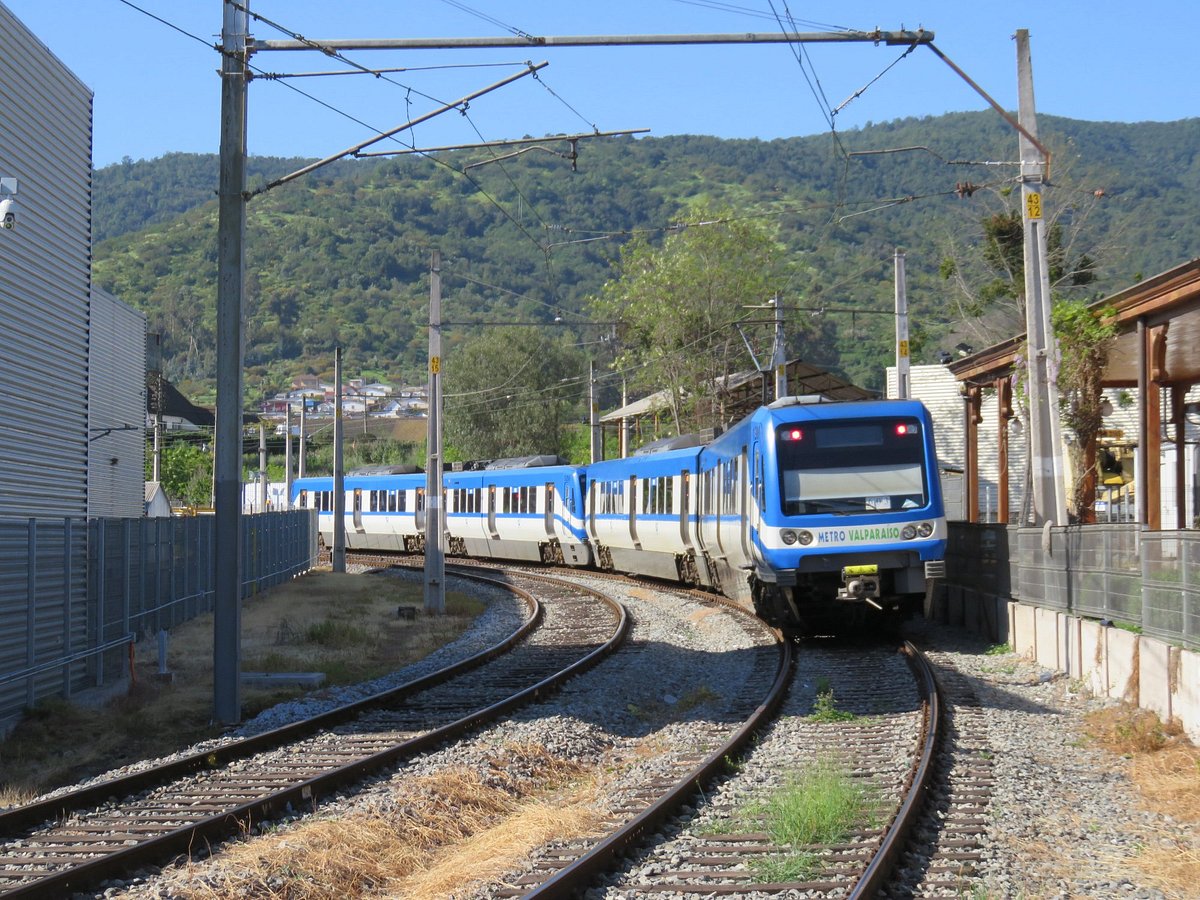
Chile is home to only two urban rail systems in the entire country, and while they share the same national ownership structure, they couldn’t be more different in character, scale, and purpose. The Metro de Santiago is a world-class rapid transit giant powering South America’s most dynamic capital city, while the Metro Valparaíso (officially known today as the Limache-Puerto service) is a charming, coastal commuter rail connecting a cluster of port cities along the Pacific. Understanding the key differences between these two systems is essential for travelers, expats, and urban transit enthusiasts alike.
Scale and Network Size
The most immediately obvious difference between the two systems is sheer size. The Santiago Metro currently operates seven lines (numbered 1–6 and 4A), serving 143 stations across 149 kilometers of revenue route, making it the most extensive metro network in South America. On any given weekday, approximately 2.6 million passengers travel through the system, and its all-time daily record stands at nearly 2.95 million passengers, set on May 3, 2019.
The Metro Valparaíso, by contrast, consists of a single line stretching 43 kilometers across just 20 stations, connecting the cities of Valparaíso, Viña del Mar, Quilpué, Villa Alemana, and Limache. In 2019 — its best recorded year — the Valparaíso system carried 20.17 million passengers annually, which is roughly what Santiago moves in about one week. The difference in scale reflects the population gap: Santiago is home to over 7 million people, while the Gran Valparaíso metropolitan area has approximately 1 million.
Type of System: Rapid Transit vs. Commuter Rail
This is perhaps the most technically significant distinction between the two systems. The Santiago Metro is a true rapid transit (subway) system — fully grade-separated, meaning it never crosses roads at street level. This allows it to maintain extremely high frequencies, with trains arriving every 2 to 5 minutes during peak hours.
The Metro Valparaíso, however, is technically a commuter rail system, not a full metro, due to the existence of numerous at-grade level crossings where trains must share intersections with road traffic. As a result, trains run approximately every 20 minutes in each direction — a much lower frequency that requires passengers to plan their journeys more carefully. The Valparaíso system does include one underground stretch: a 5-kilometer tunnel running from Miramar through Chorrillos stations beneath Viña del Mar, which is the only truly subway-like portion of the line.
Fare Structure
The two systems differ significantly in how they charge passengers, reflecting their different natures as transit networks.
The Santiago Metro uses a flat-rate fare system with slight variations based on time of day. A standard off-peak ride costs around CLP $750–800 (approximately USD $0.83–0.89), regardless of how far you travel. Passengers use the rechargeable Bip! card, which is also accepted on the city’s extensive bus network (Red Metropolitana), enabling seamless integrated transfers across the entire public transit system.
The Metro Valparaíso uses a distance-based, zone fare system divided into five zones with three time-of-day pricing tiers. Fares range from as low as CLP $410 (approximately USD $0.62) for short Zone 1 trips during off-peak hours, up to CLP $864 (approximately USD $1.31) for full end-to-end journeys during rush hour. Passengers use a dedicated Metroval card, which is scanned both upon entering and exiting stations so the system can calculate the correct distance-based fare. A short hop — for example, from Puerto station to Viña del Mar — typically costs around 400 pesos, making it cheaper than a Santiago Metro ride for short distances.
Infrastructure and Technology
| Feature | Santiago Metro | Metro Valparaíso |
|---|---|---|
| Lines | 7 | 1 |
| Stations | 143 | 20 |
| Total length | 149 km | 43 km |
| Type | Rapid transit (subway) | Commuter rail |
| Grade crossings | None | Yes (multiple) |
| Underground sections | Fully underground | 5 km tunnel only |
| Train frequency (peak) | Every 2–5 minutes | Every ~20 minutes |
| Annual passengers | ~712 million (2018) | ~20 million (2019) |
| Fare system | Flat rate (Bip! card) | Zone-based (Metroval card) |
| Operator | Metro S.A. (state-owned) | EFE Valparaíso S.A. |
The Santiago Metro is widely recognized as one of the most modern metro systems in Latin America and was elected the best metro system in the Americas at the annual Metro Rail dinner in London in 2012. Its Line 6, the newest and most technologically advanced, features cutting-edge station design, improved accessibility, and some of the smartest operational systems on the continent.
The Metro Valparaíso fleet consists of 27 articulated units, running on rubber tyres — a technical detail that makes the ride noticeably quieter and smoother compared to Santiago’s steel-wheel trains. This rubber-tyre technology is one of the most pleasant aspects of riding the Valparaíso system for first-time visitors.
History and Origins
The two systems also have very different historical origins. The Santiago Metro was inaugurated in 1975 under the Pinochet government as Chile’s first rapid transit system, initially serving a single line. It has since expanded steadily through democratic governments, becoming the backbone of Santiago’s public transportation network.
The Metro Valparaíso has older roots, but in its modern form it is significantly younger. Valparaíso had interurban passenger train service since the 19th century, but the current system was born in 2005 through a major infrastructure renovation that converted the old interurban Santiago–Valparaíso railway corridor into a more rapid transit-style commuter service. Construction began in 1999, new trains arrived in February 2005, and the renovated line officially opened on November 23, 2005.
Geographic Coverage and Purpose
The two systems serve fundamentally different geographic and social purposes. The Santiago Metro is an urban backbone, designed to move millions of people across a sprawling megacity every single day. Its seven lines criss-cross Santiago’s densest residential, commercial, and business districts, reaching neighborhoods like Providencia, Las Condes, Maipú, and Ñuñoa. It is fully integrated with the city’s bus network under the unified Red Metropolitana de Movilidad system.
The Metro Valparaíso is a regional connector, designed to link five distinct cities spread across the coastal hills and inland valleys of the Gran Valparaíso area. For locals, it’s an everyday commuter lifeline between home cities like Quilpué or Villa Alemana and workplaces in Valparaíso or Viña del Mar. For tourists, it’s a scenic, affordable way to hop between the bohemian port of Valparaíso, the beach resorts of Viña del Mar, and the quieter inland towns in a single day. Future expansion studies are even exploring extending the line further inland to serve Quillota, La Cruz, and La Calera.
Which One Should You Use?
If you’re visiting Santiago, the metro is an absolute must — it’s the fastest, safest, and most cost-effective way to navigate the capital, and its coverage is comprehensive enough to reach virtually every major tourist attraction and neighborhood in the city.
If you’re visiting the Valparaíso region, the Metroval offers a uniquely relaxed, scenic commuter experience that doubles as a tourist attraction in itself. The quieter rides, panoramic coastal scenery near Viña del Mar, and the ability to visit multiple cities on a single ticket make it a genuinely enjoyable travel experience — far more leisurely than the fast-paced, high-density Santiago Metro.
Together, these two rail systems represent Chile’s full spectrum of urban transit ambition: one a world-class metropolitan giant, the other a charming regional connector that moves at the unhurried pace of a port city built on hills.